
Curry County Sex Offender Checks
Oregon State Police Sex Offender Registration Section manages the Oregon Sex Offender Registry. It tracks people required to report who live, work, or attend school in Oregon. Curry County law enforcement receives local reports and investigates suspected noncompliance. The public site is a notification tool, not a complete list of every person convicted of a sex offense.
Start with the official Oregon search and select Curry County or a Curry city. Use NSOPW for a national cross-check, which matters along the California border. Contact OSP SOR when classification or reporting law is unclear, and contact CCSO or city police when current local information appears wrong.
Why Curry Registrants May Be Unlisted
Oregon uses assessed risk Levels One, Two, and Three. Public visibility varies by classification and disclosure rules. Level Three receives broad public Internet disclosure, while other categories have historically received narrower treatment. Not every person convicted of a sex offense must register, and not every registrant is displayed on the public website.
An empty name search therefore cannot prove that a person has no registration duty or presents no risk. Check spelling, location, aliases where available, and the national search. For a case-specific legal question, the OSP registration unit is the proper authority.
Oregon Sex Offender Registry Searches
Open the official Oregon registry and search with the best facts available. Avoid assumptions from a same-name result. Compare location, physical description, and profile details before drawing a conclusion.
- Open the Oregon Public Sex Offender Registry.
- Enter a name, address, city, ZIP code, or select Curry County.
- Choose map or list view when the interface offers it.
- Open a profile and compare public identity and location fields.
- Cross-check NSOPW for records outside Oregon.
| Field | Type | Required | Use |
|---|---|---|---|
| Name | Text | No | First, last, or supported partial name |
| Address/location | Text | No | Geographic search |
| City or ZIP | Text/select | No | Narrow to a Curry community |
| County | Dropdown | No | Select Curry |
| Map/list | View | No | Change result presentation |
Cross-Check Curry County With NSOPW
County and state systems stop at jurisdiction lines. Curry County borders California, so an Oregon-only place search can omit a record displayed by another state. The U.S. Department of Justice's NSOPW links participating jurisdictions and supports national name and location searches.
The official National Sex Offender Public Website provides that cross-state layer.
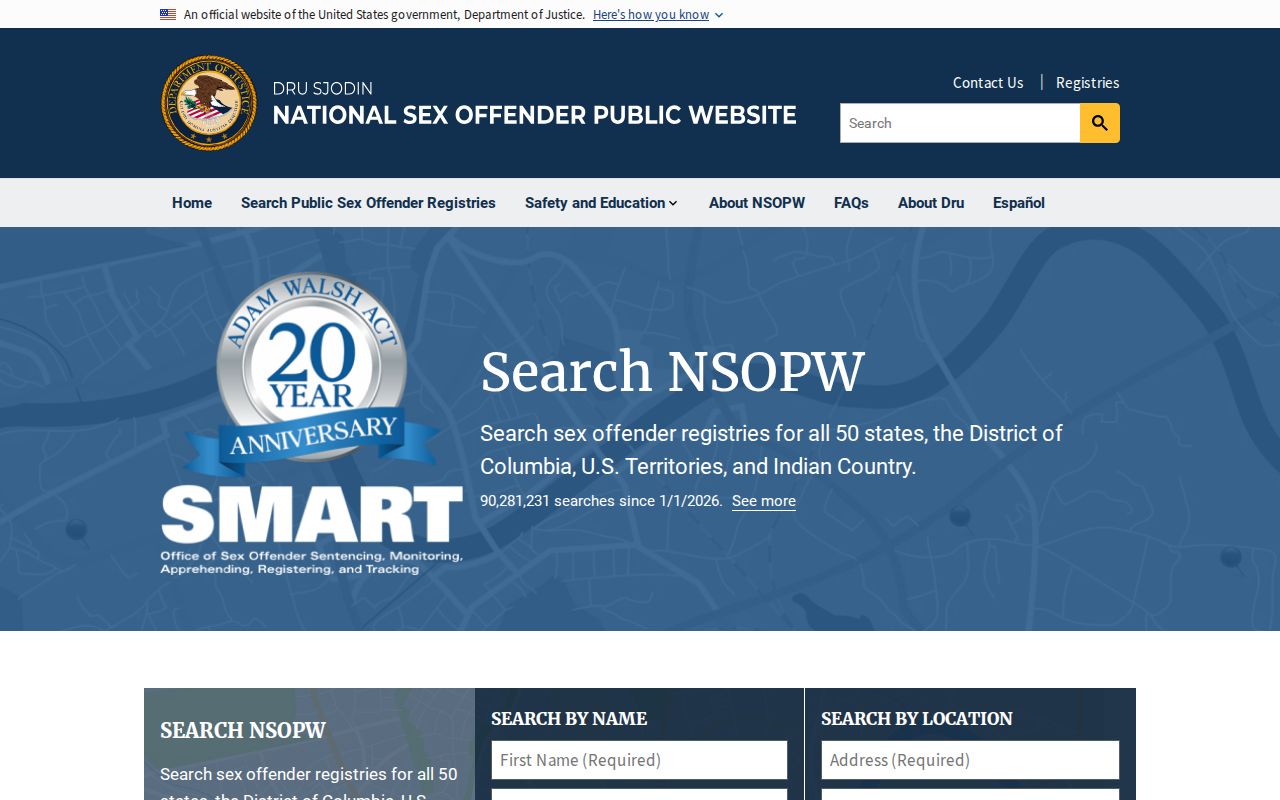
NSOPW supplements Oregon's registry. It does not replace questions to OSP about an Oregon classification or local reports to Curry law enforcement.
Registry Profiles: What They Show
Public fields vary by person and by what Oregon law permits. Treat each profile as a current official notice, then report stale data rather than trying to correct it yourself.
| Identity | Name, aliases, photograph, and physical description when public |
|---|---|
| Classification | Risk level and registration or compliance status |
| Location | Residence detail, city, ZIP, work, or school data as authorized |
| Descriptors | Vehicles, scars, marks, or tattoos when displayed |
| Offense | Statute, conviction jurisdiction and date, and approved victim categories |
| Reporting | Agency responsible for the public entry |
No field should be assumed when it is absent. The profile is not a complete court file and does not summarize every fact of the underlying case.
Curry Residence and Travel Reporting
Oregon reporting duties can be triggered by a change of residence, work, or school, annual reporting around a birthday, and international travel. Failure to report can itself be a crime. The exact duty depends on the governing offense, date, classification, and current statute.
OSP SOR's help desk is at 3565 Trelstad Avenue SE in Salem, 503-934-1258, askSOR@osp.oregon.gov, weekdays 8:00 a.m. to 5:00 p.m. The official OSP information page explains registration law and office contact.
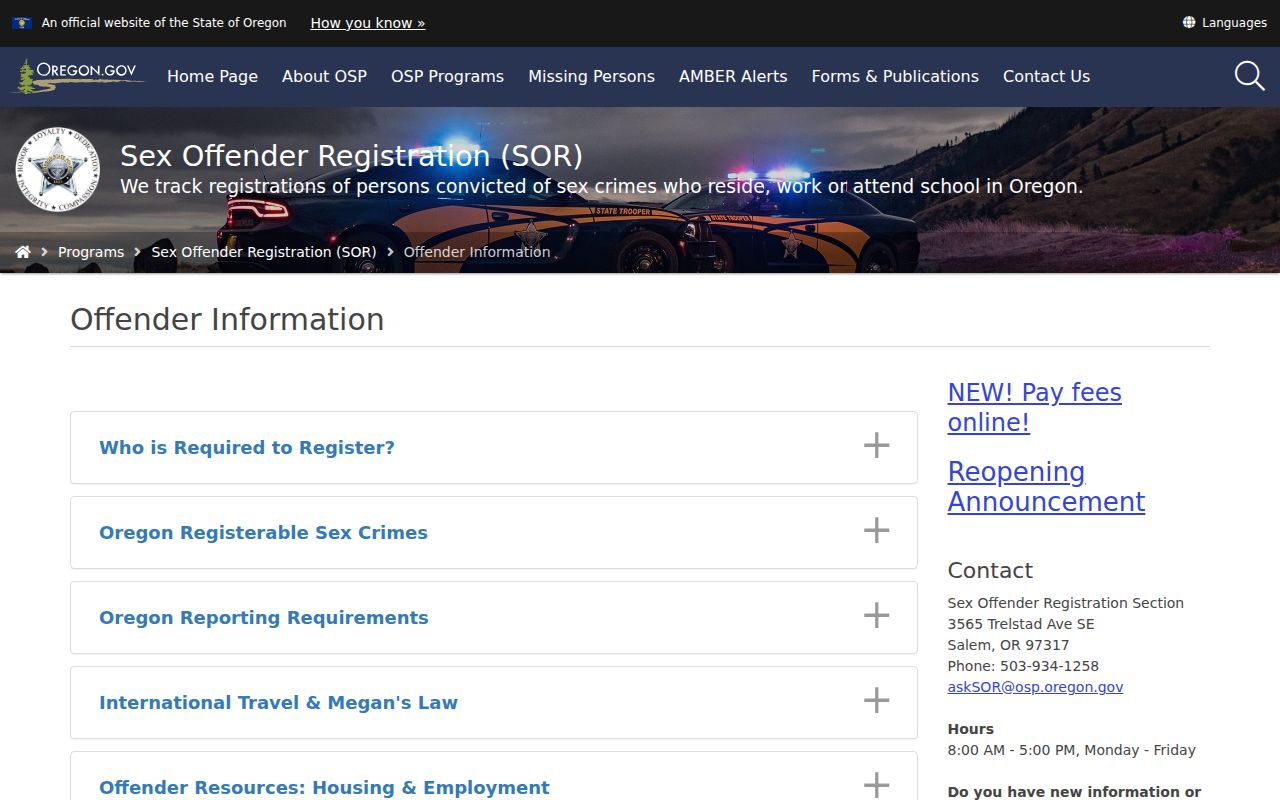
This state office answers classification and reporting questions; Curry officers handle local verification and suspected violations.
Registration Levels and Duties in Oregon
Oregon levels are risk classifications, not the federal SORNA tiers. A simple 10-year, 25-year, or lifetime chart would misstate Oregon law. Duration depends on the offense, governing date, and statutory relief or reclassification process.
| Oregon level | Public treatment | Duration |
|---|---|---|
| Level One | Lower assessed risk; historically limited disclosure | Offense and statute-specific |
| Level Two | Moderate assessed risk; targeted or community disclosure | Offense-specific; relief may require petition |
| Level Three | Highest assessed risk; broad website and community notice | Frequently lifetime unless relief applies |
ORS 163A.100 addresses classification, ORS 163A.105 through 163A.150 addresses relief and reclassification, and ORS 163A.215 through 163A.225 governs public release.
When a Curry Address Looks Stale
Do not confront the listed person or neighbors. Note the public profile, the field that appears wrong, and the reason for concern. For Curry County, call CCSO at 541-247-3242 or the relevant Brookings, Gold Beach, or Port Orford police department. Use 911 only for an emergency.
OSP SOR can answer whether a reporting rule applies, but local police investigate suspected noncompliance. A stale-looking entry may reflect update timing, authorized address granularity, or a legal disclosure limit. Reporting the concern lets the responsible agency verify it through nonpublic records.
Using Registry Information Lawfully
Registry information supports personal, family, neighborhood, and community awareness. It does not authorize threats, harassment, retaliation, discrimination, trespass, or vigilantism. A profile also does not show that an unlisted person is safe.
Verify information through OSP and the local agency that maintains it. Keep any safety response lawful, factual, and focused on present conduct rather than public confrontation.
Curry Registry Search Limits
A registry search answers a narrow public-notification question. It does not replace a Curry County court docket, an OSP criminal-history request, or direct safety planning with law enforcement. Profiles contain the fields Oregon law allows OSP to publish for that classification. They do not reproduce the whole police report, evidence, plea record, judgment, treatment file, or supervision plan. Protected victim facts and many personal identifiers remain outside public display.
Search results can also change as a person reports a new residence, work site, school, or travel event. Classification or relief proceedings may affect disclosure. Record an official profile link and the date checked when personal awareness requires a later comparison, but do not repost or alter the information. Ask OSP SOR about the registration rule and the reporting agency about a suspected factual error.
Curry's geography adds a practical limit. Oregon's county filter cannot search California, and a place search may not find a person who works in Curry County but resides elsewhere unless the public profile displays that authorized field. Run both name and location searches, try known aliases shown in official records, and cross-check NSOPW. Never infer safety from no result.
Community notification should lead to calm, lawful choices. Parents and residents can review the official map, discuss boundaries with family members, and report current suspicious conduct through the proper police channel. An emergency goes to 911. A suspected reporting violation in unincorporated Curry County goes to CCSO at 541-247-3242; a city concern goes to the relevant police department. OSP SOR remains the state contact for risk level, registration duration, and disclosure questions.
Curry Sex Offender Classification Help
Risk level, public visibility, and registration duration are related but not identical questions. A Level Three label supports broad Internet notice, yet duration still turns on the governing offense, dates, and any statutory relief. Levels One and Two can involve narrower disclosure without erasing the duty to report. The public profile cannot settle every one of those legal issues.
Call OSP SOR at 503-934-1258 for the state classification and reporting framework. For a Curry County court judgment or later order, ask the Circuit Court clerk about public case access. For current local compliance concerns, use CCSO or the city police department. Keeping those roles separate avoids treating a missing web profile as proof that no registration record exists.
Curry Registry and Court Records Differ
A public registry profile is not the underlying prosecution. Curry County Circuit Court records may show the filed counts, plea or trial result, judgment, and sentence, while the registry displays only notification fields approved under Oregon law. Offense wording and dates should be read in context, and a profile should not be used to invent facts about a victim or case.
When a lawful personal need calls for the court outcome, search OJCIN or use the free Curry courthouse terminal. When the question concerns current registration status, classification, or reporting duties, use OSP SOR. When it concerns a suspected local violation, contact the sheriff or city police. Those three channels maintain different records and may update on different schedules.
Keep Curry Registry Search Notes
For personal and family awareness, note which official system was checked, the spelling used, location filters, and the date. A later result may differ because the person reported a move, OSP updated classification data, or another jurisdiction supplied a record to NSOPW. Search notes help explain the difference without copying sensitive profile data into a new public list.
If a profile changes, return to the live Oregon registry rather than relying on a saved image. Direct legal or classification questions to OSP SOR. Send a suspected current Curry County reporting violation to the sheriff or city police, and describe the observed concern without confrontation.